|
Glenmorangie
supports National Museum of Scotland
exhibition showcasing the first thousand
years of silver in Scotland.
If you plan on visiting Edinburgh
why not stop by
a new exhibition at the National Museum
of Scotland supported by Glenmorangie
which will show for the first time how silver,
not gold, became the most important
precious metal in Scotland over the
course of the first millennium AD.
New research and recent archaeological
discoveries will chart the first
thousand years of silver in Scotland.
The exhibition will showcase Scotland’s
earliest silver, arriving with the Roman
army, and show the lasting impact this
new material had on early Medieval
Scotland.
This research is part of a unique multi
award-winning cultural partnership with
The Glenmorangie Company which is now in
its ninth year.
Alice Blackwell, Glenmorangie research
fellow at National Museums Scotland,
said: "We’re delighted to be able to
showcase the first thousand years of
silver in Scotland. This exhibition
looks at the most powerful objects made
in a new and precious material. It sheds
light on the crucial transition from
Roman Iron Age tribal society to the
first early kingdoms in Scotland that
emerged in the 4th – 9th centuries.
"It’s very exciting to be able to tell a
story of a thousand years of power and
prestige through the biography of this
one precious metal. This research would
not have been possible without the long
and enthusiastic support of The
Glenmorangie Company, and we are
extremely proud of how our innovative
partnership has enriched academic and
public understanding of Scotland’s
past."
Hamish Torrie, Corporate Social
Responsibility Director at The
Glenmorangie Company, said “We are
rooted deep in Scotland and Glenmorangie
has been delighted to support the
extensive study of the Early Medieval
period in an innovative research
partnership that is now in its ninth
year. The exhibition is another exciting
milestone in the Glenmorangie Research
Project, bringing fascinating material
and innovative scholarship into the
public eye.”
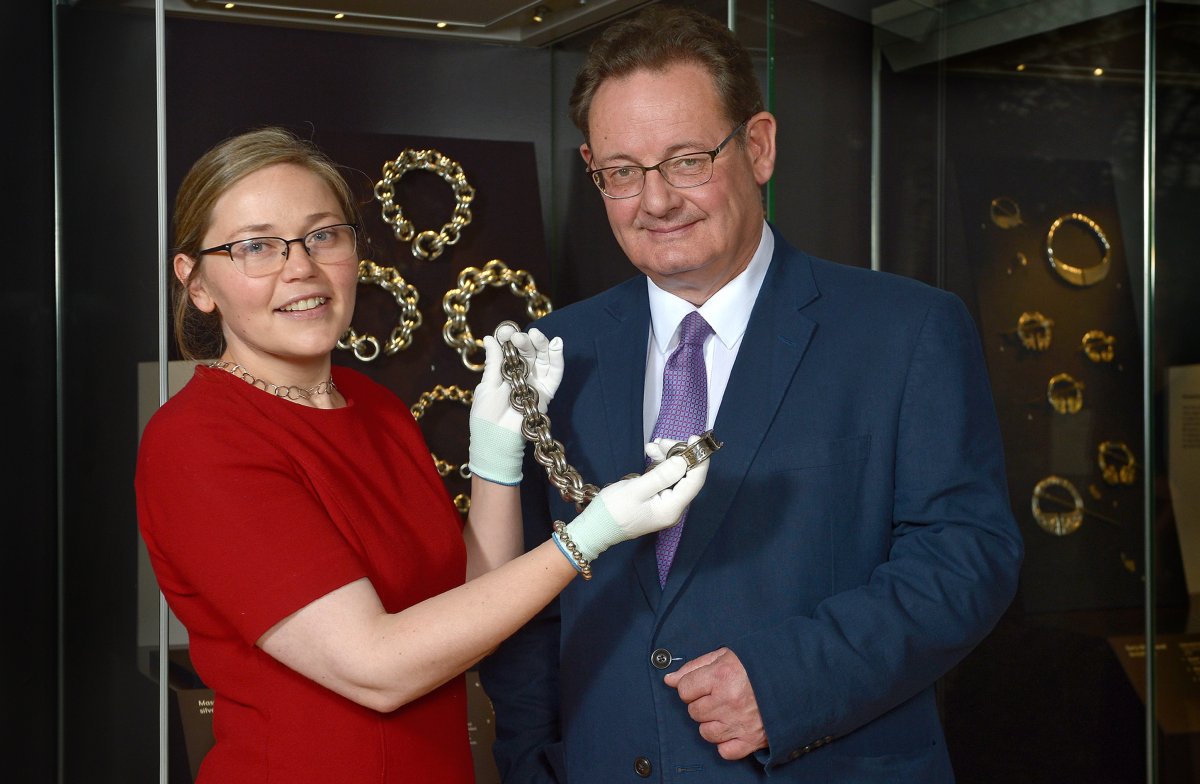
The exhibition will include the first
public display of the recently unveiled
Dairsie Hoard, which dates to the late
3rd century AD and is the earliest known
example of hacksilver from anywhere
beyond the Roman frontier.
Also on its first full public display is
the Gaulcross hoard, discovered in
Aberdeenshire in 2013. Since its
excavation, research has revealed
striking similarities with another find,
from Norrie’s Law, in Fife. Both hoards
date to the 5th–6th centuries AD and
show for the first time how earlier
Roman silver was recycled and repurposed
over the centuries.
The exhibition will be accompanied by a
book publication and a programme of
public events, and will reflect recent
scholarship undertaken to place
Scotland’s early silver in a European
context through a research network
project supported by the UK Arts and
Humanities Research Council.
The exhibition has been made possible by
an innovative partnership between The
Glenmorangie Company and National
Museums Scotland. Since 2008, this
association has supported the Museum’s
academic research and public engagement
activities and funded an archaeological
research post. The basis for the
partnership comes from eighth-century
Hilton of Cadboll Stone, on display in
the National Museum of Scotland’s Early
People gallery. The Hilton of Cadboll
stone was discovered near Glenmorangie
Distillery in Ross-shire, and is the
inspiration for the brand icon that
adorns Glenmorangie's range of single
malt whiskies.
|